Sans étiquette · Topless at the spa
Who has to cover up? A history of going topless
Less than a hundred years ago, men had to cover their chests too. The rule changed for them. Not for women.
Antiquity · Greece
At the gymnasium, you are naked
The word gymnasium comes from the Greek gymnos, meaning “naked.” In ancient Greece, athletes trained and competed naked.
At the ancient Olympic Games, all free Greek men could compete. Women were not allowed to.
Sources: OpenLearn (The Open University), the ancient Games (opens in a new tab) · Olympics.com, ten facts about the ancient Games (opens in a new tab)
Athletes are naked. Women don’t compete.
AntiquityAntiquity · Rome
At the baths, apart or together
Cold bath, warm room, hot bath: the circuit of the Roman baths already looks like our spas.
Many early baths were for men only; others had a section for women, or admitted them at other hours. Mixed bathing became popular as the Empire expanded. Several emperors, including Hadrian, banned it at times.
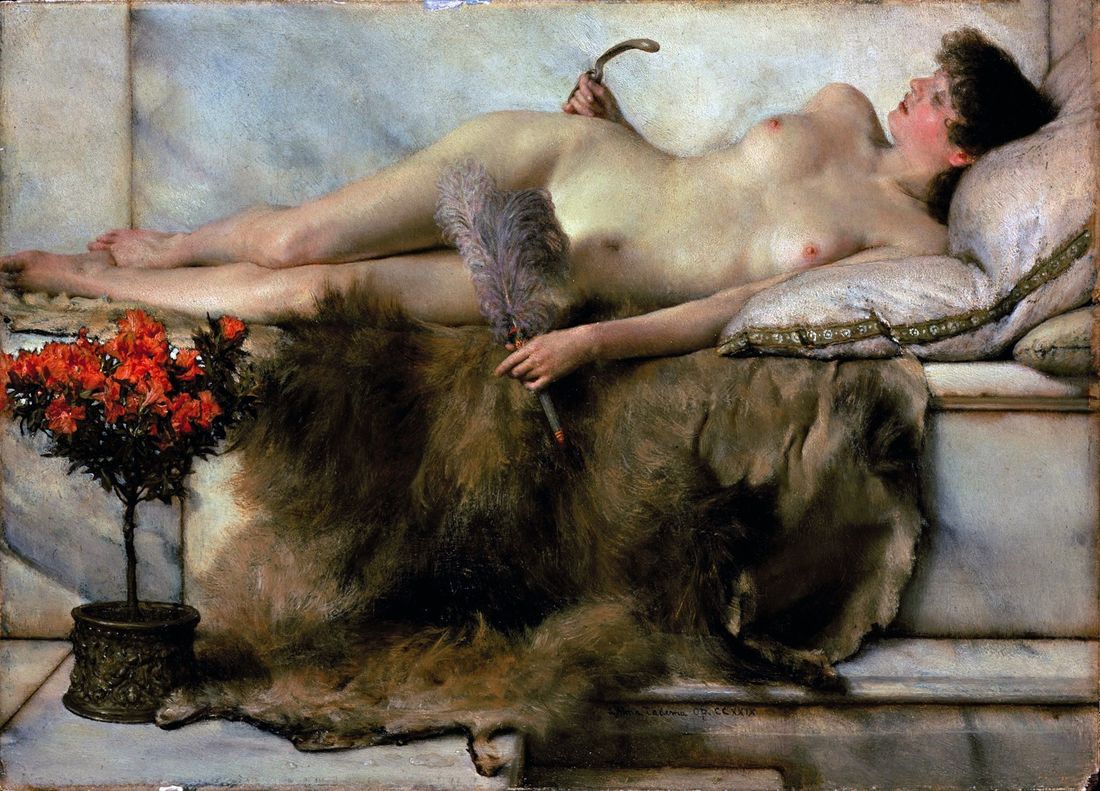
Sources: History.com, Roman baths (opens in a new tab) · FutureLearn, “Rome: A Virtual Tour of the Ancient City” (opens in a new tab) · The Tepidarium, Alma-Tadema (notice) (opens in a new tab)
Naked at the baths, usually apart.
Antiquity13th century · Paris
Étuves: steam baths in the heart of the city
In the Paris of Saint Louis, there were several dozen étuves, public steam baths much like a hammam. In 1292, 26 were counted. Men and women often bathed there together.
The Church worried, and the étuves got a bad reputation. The plague that swept Europe in the 14th century dealt them the final blow.
Sources: Livres Hebdo, on Georges Vigarello’s Le propre et le sale (opens in a new tab) · French Society for the History of Dermatology, history of washing (Callot) (opens in a new tab)
At the étuves, men and women often mix.
13th centuryHere, long before spas · First Nations
The sweat lodge, a sacred place
Long before Nordic spas, First Nations practised the sweat lodge: a heated, dome-shaped hut where ceremonies are held to purify body, mind and soul. It is a sacred place, not a leisure activity.
Depending on the community, some ceremonies are for men, women or children only; others are open to all. Until 1951, the Indian Act banned sweat lodges in Canada.
Sources: The Canadian Encyclopedia, “Suerie” (sweat lodge) (opens in a new tab)
A sacred ceremony, banned by law until 1951.
First Nations1869 · Japan
Mixed bathing banned, under Western eyes
Until the Meiji era, many public baths and hot springs in Japan were mixed. In the mid-19th century, the first Western visitors were shocked.
Wanting to be seen as an equal of the great Western powers, the Meiji government banned mixed bathing in towns in February 1869. Today in Japan, people still bathe naked, in baths separated by sex.
Sources: Japan Tourism Agency, The History of Konyoku (opens in a new tab) · Japan National Tourism Organization, bathing manners (opens in a new tab)
In Japan: naked, but apart since 1869.
18691870s · Finland and Northern Ontario
The sauna comes to Ontario
In Finland, the sauna has been practised for centuries. People usually go naked, women and men separately in public saunas.
The sauna came to Canada with Finnish immigrants, who settled in northwestern Ontario from the 1870s. Thunder Bay is now home to more than 10,000 Finnish Canadians, and its public sauna, Kangas, opened in 1967, still welcomes bathers.
Sources: Visit Finland, the sauna (opens in a new tab) · Northern Wilds, the sauna arrives in the 1870s (opens in a new tab) · Lonely Planet, Thunder Bay’s Finnish district (opens in a new tab) · The Walleye, Thunder Bay’s saunas (opens in a new tab)
In the Finnish sauna: naked, and apart.
18701881 · Montreal
Public baths, men first
In 1881, the Montreal Swimming Club refused to admit women, saying they would need a “special bathing place.” In 1889, on Île Ronde, six men and women caught bathing naked were fined $5.
In the 1880s, for workers’ hygiene, the City built its first public baths: they were for men only. The Wellington bath opened its doors to women in 1893, a first. Even in 1927, at the Généreux bath, women were allowed in only on Tuesdays and Thursdays.
Sources: Xtra, the history of beach rules in Toronto (opens in a new tab) · Cap-aux-Diamants, “Les bains publics de Montréal” (Paul Labonne, 2002) (opens in a new tab) · MEM, Centre des mémoires montréalaises, “Prendre un bain aux bains” (opens in a new tab) · Écomusée du fier monde, the Généreux Bath (opens in a new tab)
Public baths: men first.
18811891 · From neck to knees
Men’s chests had to be hidden too
In the 19th century, men often swam naked. Then the rules came. In Ocean Grove, New Jersey, a man was fined for his bathing suit as early as 1891; in 1910, bathing shirts were still mandatory for men.
In Toronto, from 1890, bathers had to wear a suit covering the body “from the neck to the knees.” In Lachine, in 1930, a bylaw required women bathing in the St. Lawrence to wear suits reaching three inches below the knee. Women defied it, and property owners sued the town.
Sources: Historical Society of Ocean Grove, “Sun, Sand & Modesty” (opens in a new tab) · Xtra, the history of beach rules in Toronto (opens in a new tab)
Neck to knees, for everyone.
18911937 · Men win
Men win the right to go topless
In the 1930s, men swam topless to defy the rules. In 1935, 42 men were arrested and fined in Atlantic City. In 1937, topless bathing was finally allowed there.
In Toronto, the Harbour Commission still appointed beach censors in 1934; two years later, it had to admit the battle was lost. In 1939, a Gallup poll found that 67% of Americans did not consider it indecent for a man to swim topless. The same year, nearly two thirds considered it indecent for a woman to wear shorts in public.
Sources: Kinfolk, a history of going topless (opens in a new tab) · Xtra, the history of beach rules in Toronto (opens in a new tab) · Gallup, June 1939 poll (opens in a new tab)
Men lose the top. Women don’t.
19371946 · Paris
The bikini: the suit shrinks, the top stays
On July 5, 1946, at the Piscine Molitor in Paris, Louis Réard unveiled a tiny two-piece swimsuit. He called it the “bikini,” after the atoll where the United States had just carried out a nuclear test.
In 1964, designer Rudi Gernreich launched the monokini, a swimsuit that leaves the chest bare.
Sources: History.com, the bikini, July 5, 1946 (opens in a new tab) · The Met, “The Bikini” (opens in a new tab)
The suit shrinks. The top stays.
19461960s · Saint-Sauveur
Quebec’s first Nordic spa
Quebec’s first Nordic spa was born in the 1960s in Saint-Sauveur, on the banks of the Rivière à Simon: first a sauna in a private home, it became the Polar Bear’s Club, now Strøm Saint-Sauveur. Nordik, in Chelsea, opened in 2005.
Quebec now has more than 100 Nordic spas, the largest concentration in North America according to Tourisme Montréal. It adopted the hot-cold-rest cycle from Scandinavia, but with a mandatory swimsuit.
Sources: Strøm Nordic Spa, the story of the Polar Bear’s Club (opens in a new tab) · Vallée Saint-Sauveur (opens in a new tab) · Tourisme Outaouais, Nordik (opens in a new tab) · Tourisme Montréal, Nordic spas (opens in a new tab)
Hot and cold come to Quebec, with the swimsuit.
19601975 to 1981 · Montreal and Toronto
Gay saunas in the police’s sights
On February 4, 1975, Montreal police raided the Sauna Aquarius on Crescent Street. It was the first time the bawdy-house law was used against a gay sauna. Before the 1976 Olympic Games, police stepped up raids on bars and saunas to “clean up” the city.
In October 1977, the raid on the Truxx bar led to 146 arrests; the next day, about 2,000 people protested. On December 15, 1977, Quebec became the first province in Canada to ban discrimination based on sexual orientation.
In Toronto, on February 5, 1981, Operation Soap targeted four bathhouses: 286 men were charged as “found-ins” in a bawdy house. The next day, nearly 3,000 people took to the streets. The raids were a turning point in relations between the police and Toronto’s gay community. The police apologized publicly in 2016.
Sources: Archives gaies du Québec, “Répression et droits civiques, 1977” (opens in a new tab) · LGLC, raid on the Sauna Aquarius, February 4, 1975 (opens in a new tab) · The Canadian Encyclopedia, the Truxx raid (opens in a new tab) · Canadian Museum of History, after the Truxx arrests (opens in a new tab) · Fierté Montréal, a history of the struggles (opens in a new tab) · Tourisme Montréal, historic LGBTQ+ milestones (opens in a new tab) · The ArQuives, Operation Soap (opens in a new tab) · The Canadian Encyclopedia, the 1981 Toronto raids (opens in a new tab) · Xtra, the Toronto bathhouse raids (opens in a new tab)
Montreal 1975, Toronto 1981: gay saunas targeted.
19751991 · Guelph, Ontario
Gwen Jacob takes off her shirt
On July 19, 1991, it was 33°C in Guelph. Gwen Jacob, a 19-year-old student, took off her shirt to cool down; the idea came to her when she saw shirtless men playing sports. She was charged with an indecent act and fined $75.
In 1996, the Ontario Court of Appeal acquitted her: being topless is not indecent. Since then, women can go topless in public in Ontario. In Quebec too, according to Éducaloi, being topless in public is legal, whatever your sex or gender.
The law doesn’t change everything. In 2015, in Kitchener, three sisters cycling topless were told by a police officer to cover up. Their rally, “Bare With Us,” drew hundreds of people.
Sources: The Peterborough Examiner, July 20, 2017 (opens in a new tab) · Yahoo News, 20 years after Gwen Jacob (opens in a new tab) · GuelphToday, 30 years after Gwen Jacob (opens in a new tab) · CBC, three sisters stopped on their bikes, Kitchener, 2015 (opens in a new tab) · CBC, the “Bare With Us” rally, 2015 (opens in a new tab) · Éducaloi, topless in public (opens in a new tab)
Ontario, 1996: a woman’s bare chest is not indecent.
19912026 · At the spa
Today, at the spa
Since 2016, Quebec’s Charter has prohibited discrimination based on gender identity or expression. Yet of the 18 spas contacted for this investigation, only one confirms that a top is optional for everyone. Five require women to cover their chest, and none writes its rule on its website.
And for trans or non-binary people, most of the answers say nothing.
Sources: CDPDJ, gender identity or expression (opens in a new tab)
5 of 18 spas still require women to wear a top.
2026And tomorrow?
The same rule for everyone
Less than a hundred years ago, men’s chests had to be hidden. The rule changed for them. It can change for everyone.
What if it were the same rule for everyone?
Tomorrow?Every reference on the site is gathered on the Sources page.